Case 03 · Townside Village by Warwickshire Homes – Willoughby, Langley BC (via Fifth Avenue Real Estate Marketing)
Designing a Buyer Experience Around Location Value
Townside Village had a real location advantage in one of BC's most competitive townhome submarkets. The work was making buyers understand that value early, clearly, and consistently – before the conversation defaulted to price comparisons with woodframe competitors a few blocks away. I helped shape a connected customer experience across the buyer journey, from online research to the presentation centre to live sales conversations: a touchscreen-led sales tool, mirrored website narrative, lifestyle content, plan comparison, and interactive product storytelling that made location feel like a tangible advantage. The result: a 6–10% pricing premium, #1 absorption, #2 price per square foot, and a repeatable CX model for future housing projects.
Results at a glance
Full numbers ↓- Website and presentation centre told the same story – reducing the gap between online research and in-person sales
- 1:1
- Pricing premium held across comparable plan types
- 6–10%
- In absorption among nearby woodframe townhome competitors
- #1
Experience continuity
Conversion lift
Pipeline visibility
01 · Problem
The starting point.
Context
Delivered in role as Project Campaign Specialist at Fifth Avenue Real Estate Marketing – full-scope marketing & sales consulting, brand development, sales integration.
Willoughby (Langley, BC) is one of the most active townhome submarkets in BC, with strong competing projects within blocks. Townside Village is a multi-phase Warwickshire Homes development: 93 townhomes in Phase 1, with up to 303 condominiums planned in future phases (~396 total units at full build-out).
Buyers had a lot to compare – plans, availability, and lifestyle value across multiple high-quality offerings.
Townside's location was the standout in the area: closer to daily amenities than any direct comp.
The strategic call: claim "the best new home location in Willoughby" as the positioning, supported by the project's "beside is better" campaign line (tagline coined by a colleague at Fifth Avenue).
Challenges to solve
- Establish perceived value immediately in an active, incentive-heavy market
- Maintain narrative continuity between online research and in-centre conversations
- Translate a real location advantage into something buyers could feel in minutes
- Make "the best new home location in Willoughby" tangible enough to support a pricing premium
02 · What I did
The plan, and the moves.
Plan
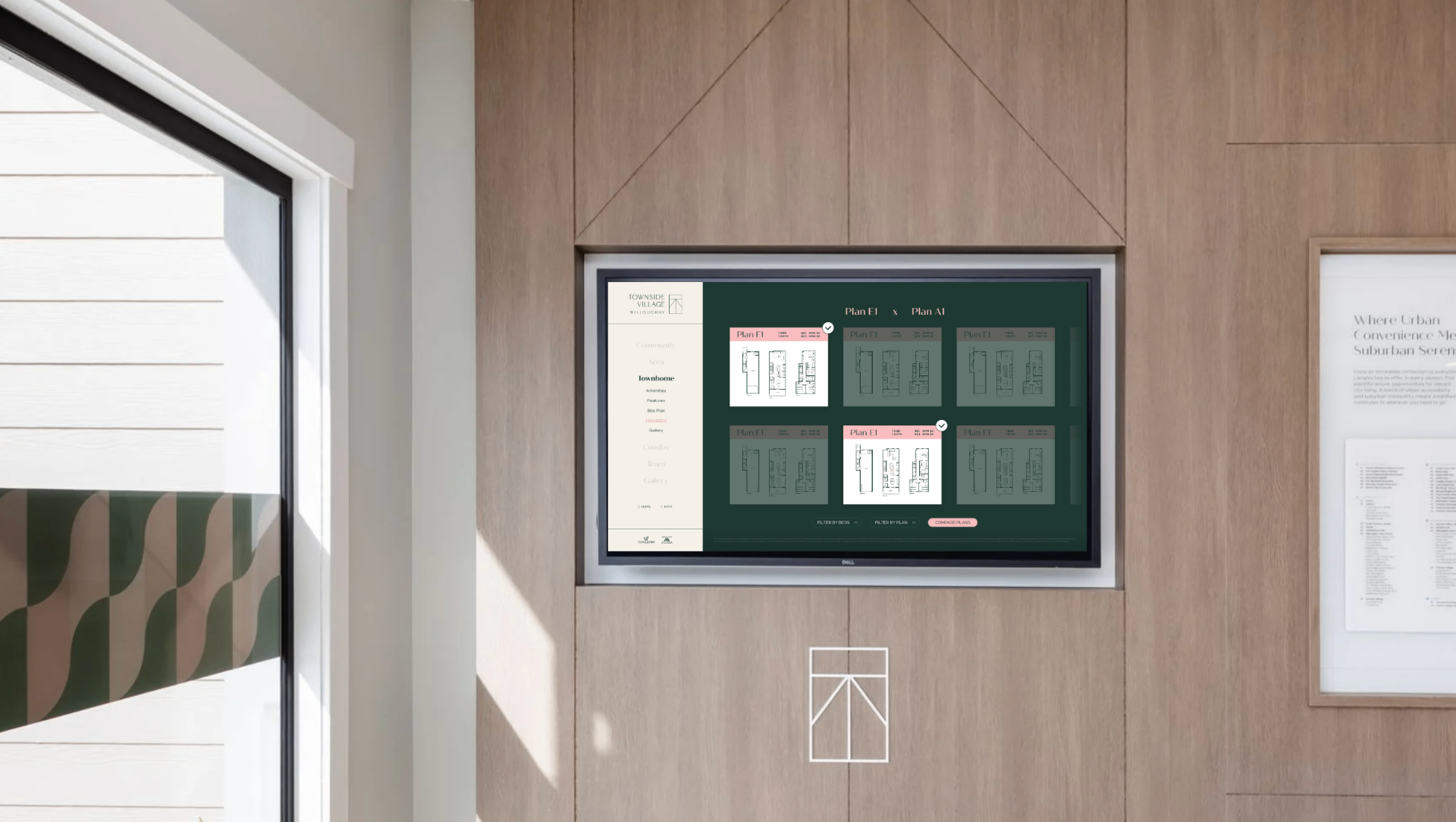
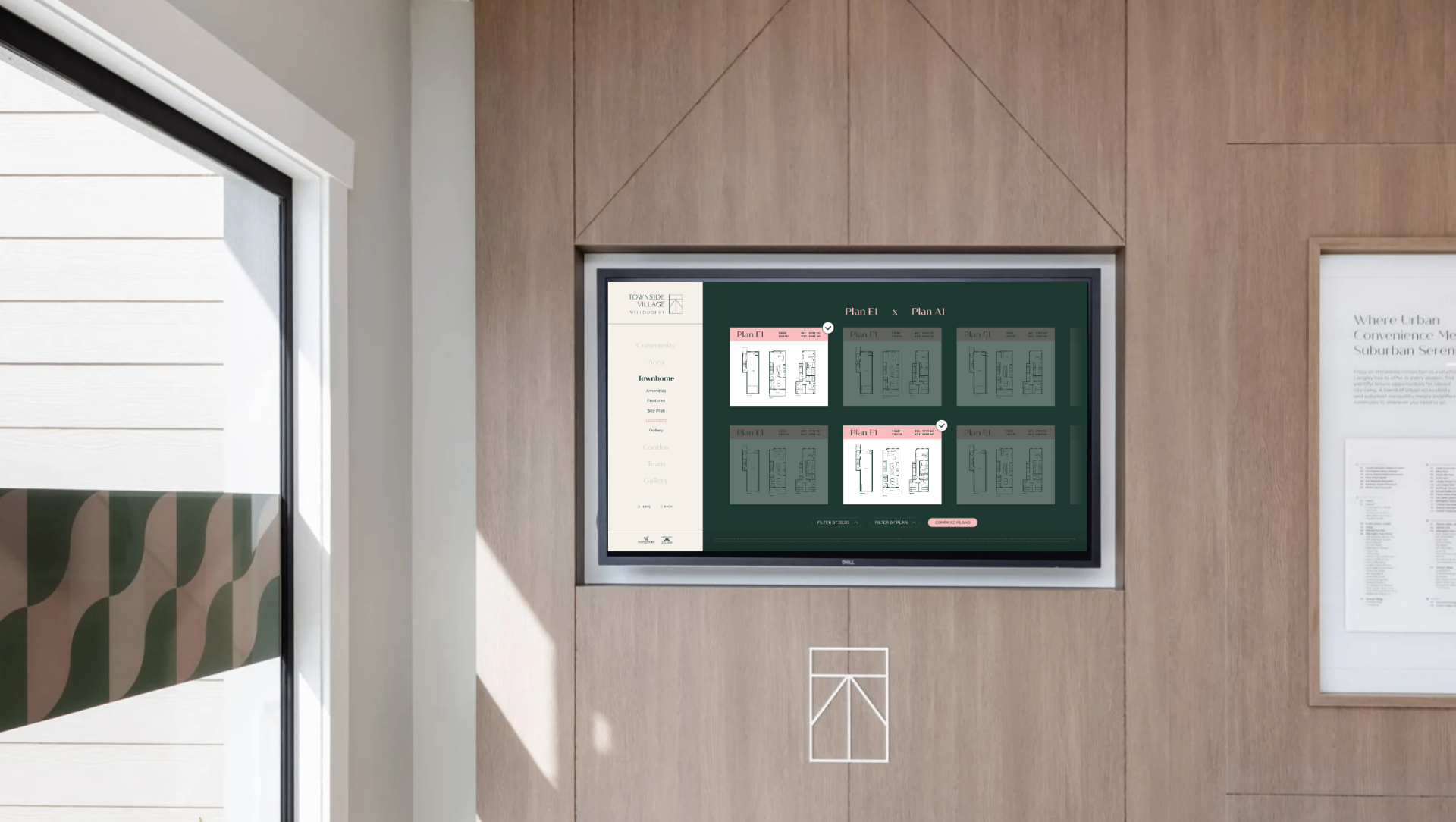
- Launch with a touchscreen-led presentation centre as the primary sales tool
- Mirror the touchscreen structure and narrative on the website for continuity
- Anchor the experience around location and lifestyle value, not price
- Build side-by-side plan comparison to accelerate buyer decisions
- Create a local lifestyle module connecting proximity to retail, services, and daily convenience
- Add interactive hotspots and inline callouts that tie renderings to lifestyle value
- Work alongside the sales team in live use and iterate against friction points
Actions & what changed
Action
Launched with an elevated touchscreen experience as the primary sales tool
What changed
First impressions established perceived value immediately in an active market
Action
Mirrored the touchscreen structure and narrative online
What changed
Buyers moved between online research and in-centre conversations without losing continuity
Action
Anchored the experience around location and lifestyle value with clear positioning and structured content
What changed
Conversations led with location and lifestyle instead of defaulting to price comparisons
Action
Built side-by-side plan comparison with clear, scannable differences
What changed
Reduced comparison friction and accelerated buyer decision-making
Action
Created a local lifestyle module highlighting proximity to retail, services, and daily convenience
What changed
Made the best-location claim tangible – location became a felt advantage, not a slogan
Action
Added interactive hotspots and inline callouts to connect renderings to lifestyle and product value
What changed
Visuals started justifying premium pricing instead of just generating interest
Action
Worked alongside sales teams in live use and iterated against friction points
What changed
The tool performed in real sales conversations, not just in demos
Project timeline
Phase 1
Strategy & narrative
- Claimed "the best new home location in Willoughby" as the positioning, supported by the existing "beside is better" campaign line
- Mapped the buyer journey from online research into the presentation centre
- Aligned sales, marketing, and product on a single location-led story
Phase 2
Build the experience
- Designed and built the touchscreen-led presentation centre as the primary sales tool
- Mirrored the touchscreen structure and narrative on the website for continuity
- Created side-by-side plan comparison, lifestyle module, and interactive hotspots
Phase 3
Run, iterate, scale
- Worked alongside the sales team in live use and refined against friction points
- Tuned content and flows as competitive moves and incentives shifted
- Extended the touchscreen model across future ownership, rental, and other housing types
Traditional sales centre vs. touchscreen-led experience
How the buyer experience changed once the presentation centre and website told the same story.
Before
- Conversations defaulted to price and incentive comparisons
- Online research and in-centre pitch told slightly different stories
- Plan and pricing comparison happened on paper, slowly
- Location had to be re-explained by sales reps on every visit
After
- Conversations anchored on location and lifestyle value
- Online and in-centre narrative matched – no translation losses
- Side-by-side plan comparison built into the touchscreen
- Lifestyle module made the best-location claim tangible without a sales pitch
03 · Outcomes
Quantified results.
By the numbers
6–10%
Pricing premium across comparable plan types
#1
Absorption among nearby woodframe townhome competitors
#2
In price per square foot among nearby woodframe townhome competitors
Repeatable
Touchscreen-led CX model now extending across future ownership, rental, and other housing types
Bottom line
Claiming "the best new home location in Willoughby" was the positioning call. The developer's "beside is better" campaign supported it. The touchscreen made the whole thing real – a way for buyers to feel what location was actually worth, instead of waiting for a sales rep to explain it for the fourth time. That's the part of the work that's hard to put on a spreadsheet and easy to undervalue. Until it shows up in the absorption numbers.
Designing a Buyer Experience Around Location Value – project gallery
Credits
- Brand, Touchscreen, and Presentation Centre Graphics Designed by Mantis
- Graphics and Signage Production by Rapid Signs
- Interior Design by The Collaborative Design Studio (CDS)
Similar services.
Scope a project on any of these directly, or send the brief and we'll sequence them together.
FAQ
Answers, briefly.
- How was the experience standard implemented?
- Positioning was locked first – "the best new home location in Willoughby," supported by the project's "beside is better" campaign line (coined by a colleague at Fifth Avenue) – then the touchscreen-led presentation centre and the website were built against the same narrative: side-by-side plan comparison, a local lifestyle module, and interactive hotspots tying renderings to lifestyle value. The sales team ran it in live use and refined against friction points.
- What was the timeline?
- Strategy and narrative first, then the build of the touchscreen + mirrored web experience, then ongoing iteration against live sales conversations as competitive moves and incentives shifted in-market.
- What did success look like?
- A 6–10% pricing premium across comparable plan types, #1 in absorption among nearby woodframe townhome competitors, and a touchscreen model now extending across future ownership, rental, and other housing types.