Case 05 · Fifth Avenue Real Estate Marketing – 3–5 active projects in parallel
Keeping 3–5 Active Projects Moving Through a Downturn
When the market slowed and the team got leaner, the work still had to ship – three to five active projects in parallel, through a downturn outside and attrition inside with no backfill coming. Without a clear cadence, things would have slipped and quietly stayed slipped. We installed a ClickUp Sprint and Backlog system that gave a stretched senior marketing team visibility, ownership, and a real Tuesday-morning way to keep moving. The result: 80+ tasks completed per month at ~76% completion rate, carrying ~18% of the Projects team's total workload.
Results at a glance
Full numbers ↓- Weekly Sprint Reporting Dashboard surfaced bottlenecks as they happened
- Real-time
- Sprint completion rate sustained through downturn and attrition
- ~76%
- Active projects tracked in parallel with clear ownership and prioritization
- 3–5
Lead response
Conversion lift
Pipeline visibility
01 · Problem
The starting point.
Context
Delivered in role as Project Campaign Specialist at Fifth Avenue Real Estate Marketing, embedded with the head-office Projects team (~25 people) running multiple active BC real estate developments.
The company had recently invested in Agile/Scrum training, opening a window to apply those principles in practical project work.
Existing ClickUp knowledge paired with newly learned Agile/Scrum practices – Sprint and Backlog processes designed in collaboration with the Director of Project Transformation.
All of it carried out while managing a portfolio of 3 to 5 active projects at any given time.
Execution happened during a prolonged market downturn, significant employee attrition, and no equivalent backfill.
Challenges to solve
- Existing execution needed a more structured system for prioritization, visibility, and consistency
- Adoption required collaboration with the execution team and ongoing refinement based on real-world use
- Manual coordination and shifting priorities created pressure across launches, releases, staff, and vendor management
- The opportunity was to improve process efficiency, strengthen prioritization, and create a more repeatable operating model under pressure
02 · What I did
The plan, and the moves.
Plan
- Apply ClickUp experience and Agile/Scrum practices to design Sprint and Backlog workflows
- Collaborate with the Director of Project Transformation on the system design
- Roll out, champion adoption, and refine through iteration with the execution team
- Use the new structure to support prioritization, planning, and task flow across active projects
- Hold structure and momentum through downturn conditions and team turnover
- Test and improve Sprint and Backlog templates through real-world use
Actions & what changed
Action
Designed Sprint and Backlog workflows in ClickUp in collaboration with the Director of Project Transformation
What changed
Agile/Scrum training translated into a practical operating system, not a theoretical framework
Action
Built workflows that improved organization, ownership clarity, and execution consistency across active work
What changed
Execution gained a structured system for prioritization and visibility across the portfolio
Action
Championed rollout, encouraged team use, and refined the system through iteration and collaboration
What changed
Adoption stuck across the execution team instead of stalling after launch
Action
Used the new structure to support ongoing prioritization, planning, and task flow across active projects
What changed
Manual coordination and shifting priorities stopped derailing execution week to week
Action
Maintained structure and momentum during a prolonged downturn and significant internal turnover
What changed
Delivery risk from market conditions and attrition was absorbed without losing execution speed
Action
Tested and improved Sprint and Backlog templates through real-world usage and continuous refinement
What changed
Process improvement stayed practical – refined against actual team use rather than theory
Project timeline
Phase 1
Design
- Translated Agile/Scrum training into a practical Sprint + Backlog model in ClickUp
- Co-designed the system with the Director of Project Transformation
- Built templates around how the team actually worked week to week
Phase 2
Rollout
- Championed adoption across 3–5 active projects in parallel
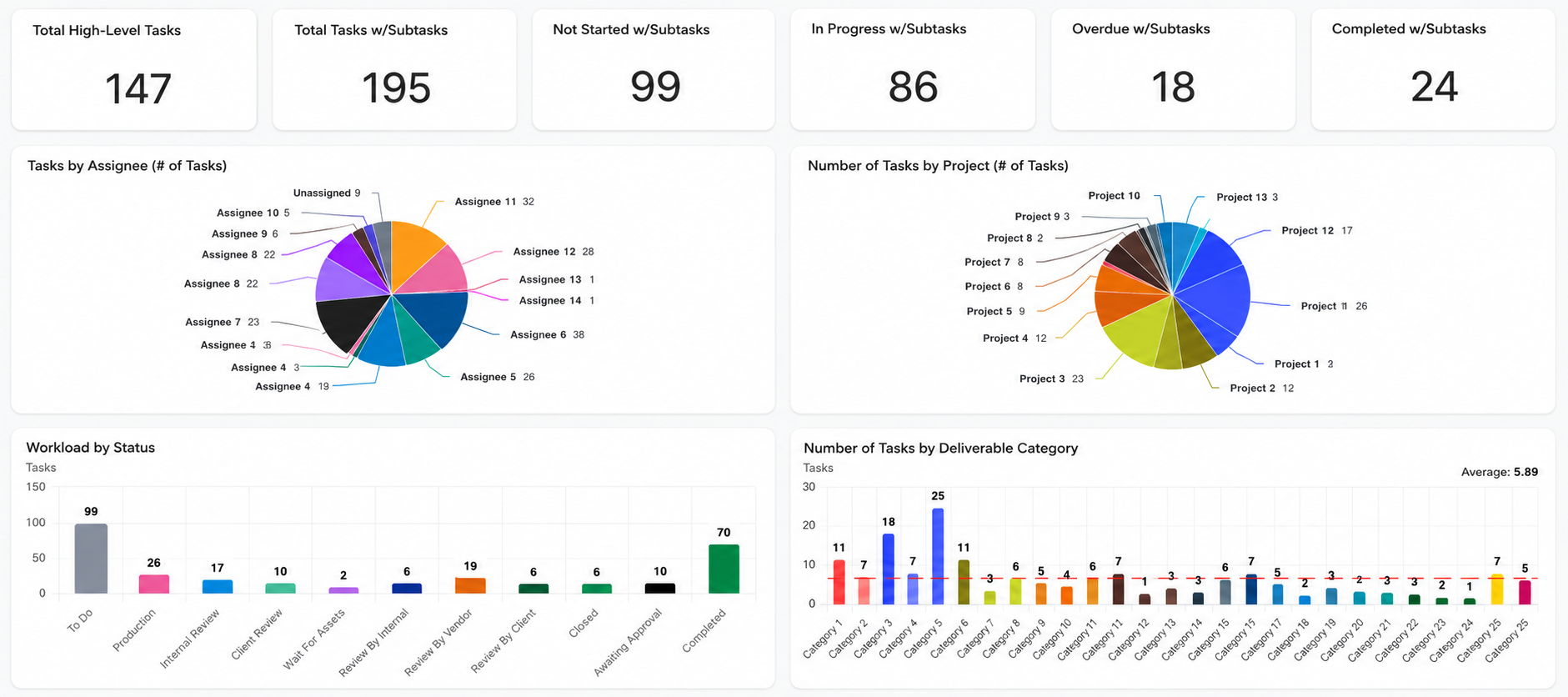
- Stood up the Weekly Sprint Reporting Dashboard as the shared view
- Reset ownership, prioritization, and cadence with the execution team
Phase 3
Sustain through pressure
- Held structure through a prolonged downturn and significant attrition with no backfill
- Refined Sprint and Backlog templates from real-world use, not theory
- Sustained 80+ tasks shipped per month at ~76% completion across the portfolio
Weekly Sprint Reporting Dashboard
Fragmented manual tracking became a real-time system – prioritization, workload visibility, and early bottleneck detection across multiple active projects.
Before
- Limited visibility across portfolio teams
- Manual updates became quickly outdated
- No clear ownership or prioritization
After
- Real-time workload visibility
- Clear task ownership
- Bottlenecks flagged early
- Cross-portfolio prioritization
03 · Outcomes
Quantified results.
By the numbers
80+
Tasks completed per month on sustained average
~76%
Completion rate
18%
Of total Projects team task workload across a 25-person head office during this period
3–5
Active projects led in parallel through downturn and attrition
Bottom line
This is the case study I almost left out of the portfolio. Operational work doesn't photograph well. It doesn't have a launch event or a hero shot. But it's the difference between a team that ships during a downturn and a team that goes quiet – and that distinction earns its place on a page.
Similar services.
Scope a project on any of these directly, or send the brief and we'll sequence them together.
FAQ
Answers, briefly.
- How was the Sprint + Backlog standard implemented?
- Designed in ClickUp with the Director of Project Transformation, then championed across 3–5 active projects with the Weekly Sprint Reporting Dashboard as the shared view. Templates were refined from real-world team use rather than theoretical framework.
- What was the timeline?
- Design, rollout, and sustained refinement – held through a prolonged market downturn and significant attrition with no equivalent backfill.
- What did success look like?
- 80+ tasks shipped per month at ~76% completion across 3–5 parallel projects – roughly 18% of the head office's total Projects-team workload – with real-time workload visibility and bottlenecks flagged early.